Supporting STEM Development With The Rocket Ship Tent
 Jordan HaleStaff Writer
August 25, 2026. This exploration details how immersive play environments facilitate early science and math concepts for young learners. It is designed for parents and educators seeking to integrate physical activity with cognitive development.
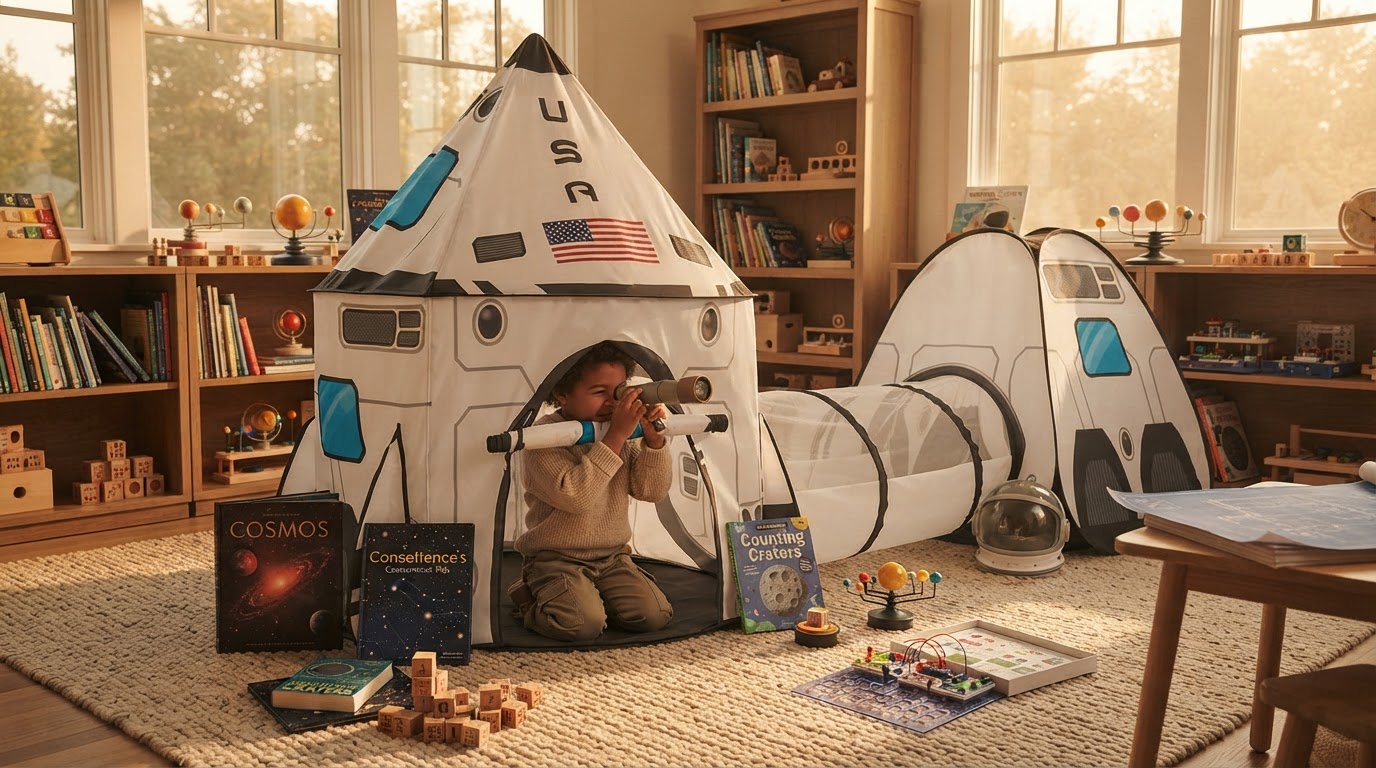
The first thing I noticed was the quiet focus that takes over a room when a child steps into a dedicated play space. There is a specific kind of cognitive heavy lifting that happens when a preschooler decides they are no longer in a living room, but orbiting a distant moon. We often talk about STEM—science, technology, engineering, and math—as a series of desk-bound tasks, but for a four-year-old, it is a full-body experience. According to Learning Resources, space-themed activities are essential because they naturally bridge the gap between abstract scientific concepts and tangible, creative play. When a child engages with a Best Birthday Gift For 4 Year Old Boy Space Theme, they aren't just playing; they are experimenting with the physics of their own environment. They are learning about volume as they crawl through narrow openings and understanding structural integrity as they navigate the walls of their vessel. The challenge for most parents is finding tools that support this without feeling like a clinical lesson plan. Somewhere around week two of observing this kind of play, I realized that the physical boundaries of a tent actually help sharpen a child's internal map of the world. By creating a physical 'mission control,' we give them a laboratory where they can test hypotheses about gravity, distance, and engineering without the pressure of a formal classroom setting.
It turns out that the physical design of the Rocket Ship Tent serves as more than just a backdrop; it is a functional tool for spatial reasoning. When setting up a Rocket Ship Tent For Kids, the assembly itself becomes a lesson in geometry and sequencing. The structure utilizes a pop-up mechanism that creates a defined three-dimensional volume, helping children visualize how flat surfaces become complex shapes. This is a core component of early engineering. The tent often features vibrant graphics of control panels and celestial bodies, which serve as prompts for complex narrative play. In my experience, these visual cues act as 'soft' STEM prompts. A child might look at a printed dial and decide they need to calculate the fuel for a trip to Mars, naturally stumbling into basic arithmetic. The inclusion of a Galaxy Play Tent With Tunnel adds a layer of kinetic learning. Crawling through a tunnel requires a child to coordinate their limbs while maintaining a sense of direction in a confined space—a skill known as proprioception, which is foundational for later physical science studies. The specific dimensions of an outer space tent with tunnel provide a safe, enclosed environment where sensory-seeking children can regulate their emotions, which is a prerequisite for the deep focus required for STEM learning. Unlike heavy wooden structures, this lightweight fabric allows for easy reconfiguration, teaching kids that their environment is something they can manipulate and improve through their own design choices.
I keep coming back to the idea that the right environment is the silent teacher in the room. When choosing a space-themed play structure to support educational goals, the decision should be based on how well the item encourages self-directed exploration. As noted by Educational Insights, toys like the Design & Drill Bolt Buddies Rocket are excellent for fine motor skills, and pairing such tactile toys with a larger rocket ship tent for kids creates a comprehensive learning zone. You want a setup that feels like a destination rather than just another toy in the bin. A high-quality galaxy play tent with tunnel should offer enough interior height for a child to stand or sit comfortably while manipulating other STEM tools, like a telescope or a set of constellation cards. It is about creating a ecosystem of learning where the tent acts as the hub. When evaluating a new addition to your child's playroom, consider these specific criteria to ensure it supports their cognitive growth:
- Does the structure offer multiple points of entry or a tunnel to encourage physical problem-solving and navigation?
- Is the interior large enough to accommodate secondary learning tools like books, tablets, or building blocks?
- Are the visual elements accurate enough to spark questions about real-world space exploration and astronomy?
- Can the tent be easily moved to different lighting conditions to experiment with shadows and 'starlight' effects?
- Does the material provide a durable but breathable environment for extended periods of deep, focused play?
Sources
Photo by cottonbro studio on Pexels
- Space Learning Activities for Kids - Learning Resources
- NASA Toys & Space-Themed Educational Gifts - The Space Store
- STEM Toys and Wooden Building Blocks for Kids - Guidecraft