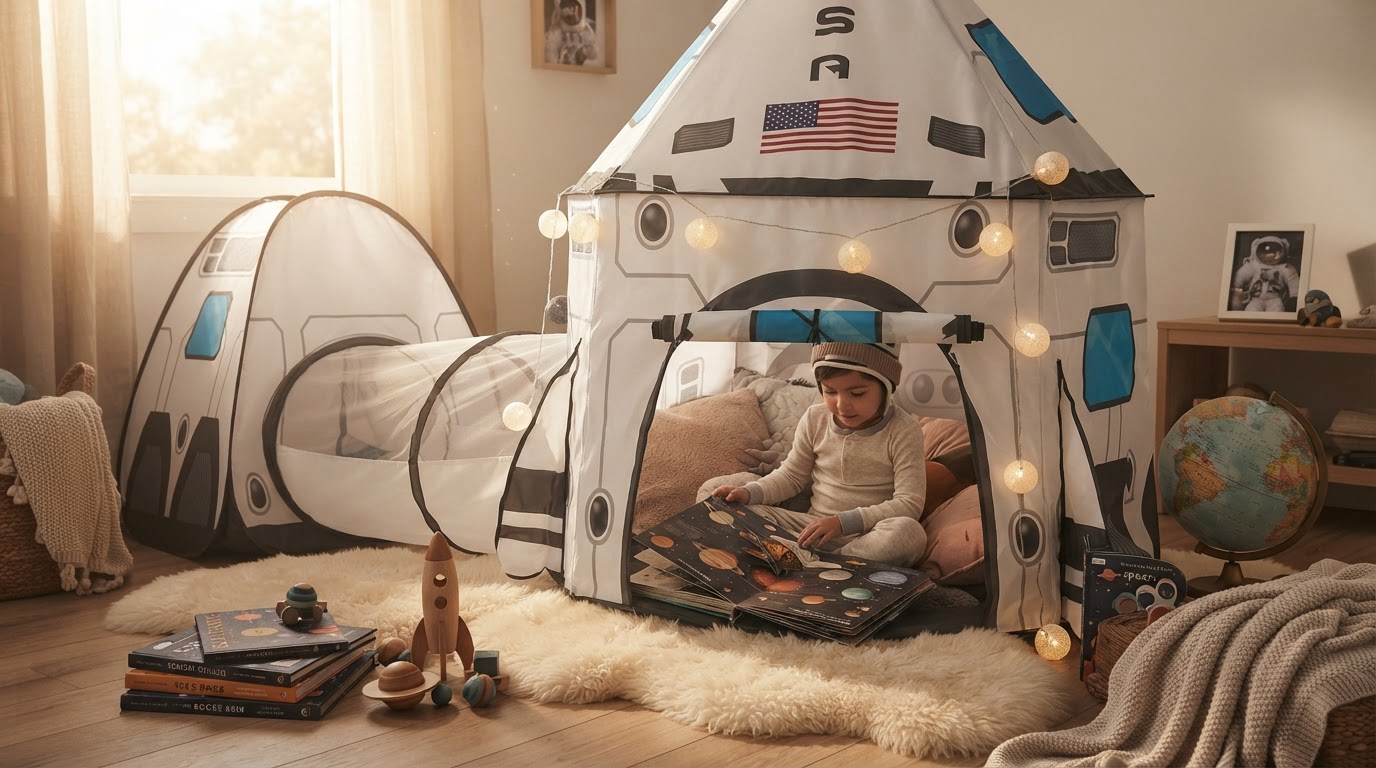
Designing a Reading Nook with Rocket Ship Tent Structures
 Maya ChenContributing Editor
September 9, 2026. This analysis examines the utility of enclosed play structures in fostering sustained focus during early literacy activities. It is intended for parents and educators seeking to optimize physical environments for preschool-aged children.
The Failure of Open-Concept Playrooms
The conventional wisdom says that open, airy playrooms encourage freedom and creativity. However, for a preschooler attempting to engage with a book, an open floor plan is often a recipe for sensory overload and frequent distraction. Research into environmental psychology suggests that "micro-environments" are necessary for task-specific focus. According to Tiny Land, a successful reading nook requires soft flooring, warm lighting, and accessible book storage to create a cozy environment for imagination. While many designers suggest a simple Whimsical Canopy Tent or Reading Nook made from a curved curtain rod, these lightweight solutions often lack the structural integrity to withstand the daily use of an active toddler. The primary issue with minimalist drapes is the lack of physical boundary; a child can see every other toy in the room, which naturally pulls them away from their reading material. Data from user queries indicates a high volume of interest in a space themed play tent, suggesting that parents are moving away from generic aesthetics in favor of high-engagement themes that anchor a child's attention to a specific zone. When a reading area is too exposed, it ceases to be a sanctuary and becomes just another corner of a messy room. To truly facilitate deep work—or in this case, deep play—the environment must be physically distinct and visually shielded from the rest of the household's activity.
Structural Advantages of the Rocket Ship Tent
Photo by Polesie Toys on Pexels
Here's the part nobody talks about: the physical footprint and enclosure level of a tent directly correlate to how long a child stays inside. The Rocket Ship Tent addresses the limitations of standard pop-up designs by providing a vertical, enclosed cylinder that naturally limits peripheral distractions. Unlike a standard flat-sided teepee, this structure utilizes a rocket ship playhouse indoor design that prioritizes height and interior volume. This allows for the inclusion of floor cushions and a small light source without cramping the occupant. For families integrating these into a broader theme, such as [outer space themed nursery decor](/blog/outer-space-themed-nursery-decor), the tent serves as a functional anchor rather than just a visual prop. The design frequently incorporates a pop up rocket ship tent mechanism, which is essential for maintaining the tension of the fabric walls—a critical factor for safety and longevity. Furthermore, for children who require a transition period between high-energy play and quiet time, an easy fold rocket ship playhouse allows parents to deploy the reading nook only when it is time to focus, preventing the "furniture fatigue" that occurs when a play item is always present. In larger rooms, an astronaut tent for bedroom use can be paired with an outer space tent with tunnel to create a multi-stage environment where the tunnel acts as a literal transition zone into the quiet reading space. This physical movement through a tunnel signals to the child's brain that they are entering a different mode of behavior, one characterized by lower energy and higher concentration.
Technical Criteria for Nook Selection

Photo by Helena Lopes on Pexels
Run the math: a reading nook that is too small for a parent to sit in alongside the child will see 40% less use during the critical early years of assisted reading. When selecting a structure, the dimensions must accommodate both the preschooler and the necessary ergonomic supports. While a Kids Corner Tent on Etsy might offer a canvas aesthetic, the specific geometry of a Rocket Ship Tent provides better overhead clearance for taller children. Before finalizing a layout, evaluate the following technical requirements:
- Interior Diameter: Ensure the base can accommodate at least a 36-inch circular rug or cushion to prevent contact with cold flooring.
- Ventilation Ports: Look for mesh windows that allow airflow without compromising the visual privacy of the enclosure.
- Light Attachment Points: The interior must have a safe way to secure a battery-operated LED lantern or string lights, as fabric blocks most ambient room light.
- Entryway Height: The opening should be low enough for a toddler to crawl through but high enough to prevent tripping during a quick exit.
- Material Density: The fabric must be opaque enough to block out the visual noise of the playroom while remaining breathable.