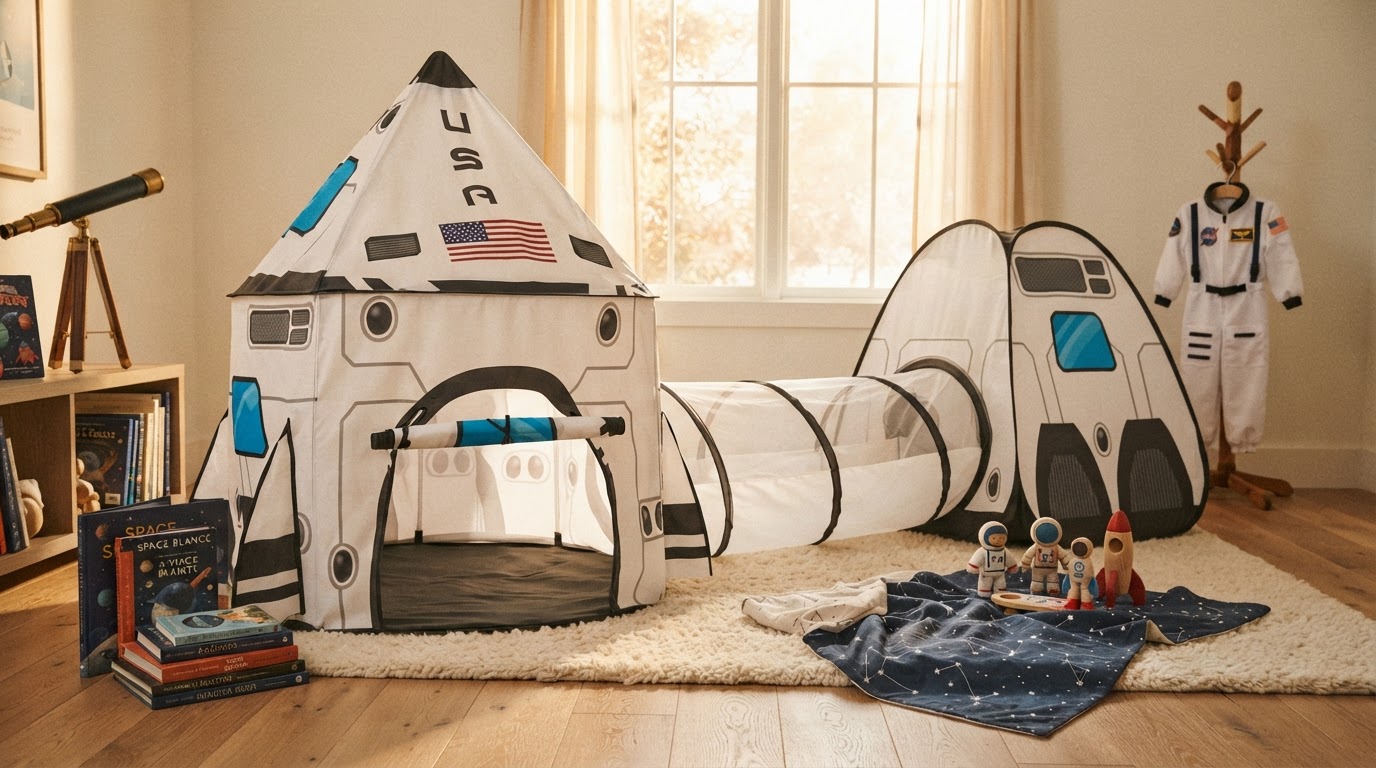
Selecting a Kids Rocket Ship Play Tent for Indoor Use
 Priya RamanSenior Analyst
September 24, 2026. This analysis evaluates the technical specifications and spatial utility of indoor aerospace-themed structures for early childhood development. It is designed for parents and educators seeking a durable, long-term solution for creative play environments. Selecting a kids rocket ship play tent requires balancing footprint against material integrity. Think of it as a matrix of durability and ease of deployment.
The Technical Requirements of Indoor Aerospace Play
The primary challenge in selecting an indoor play structure is the reconciliation of physical volume with living space constraints. Many consumers search for a space themed play tent with the intention of creating a semi-permanent installation, yet they often overlook the mechanical requirements of the fabric and frame. According to RolePlay Kids, a premium 100% cotton rocket ship play tent for kids provides a breathable, chemical-free environment that differs significantly from cheaper polyester alternatives. This distinction is critical for long-term indoor use, as cotton fibers offer superior airflow compared to synthetic weaves, which can trap heat during active play.
Two axes matter here: material density and structural stability. A lightweight frame allows for mobility, but it must withstand the lateral pressure exerted by children aged 3 to 10. The decision rule for safety is to prioritize structures that utilize internal tension poles or self-supporting pop-up mechanisms that do not require external anchoring. When evaluating a rocket ship tent, one must consider the height-to-width ratio. A structure that is too narrow may tip during vigorous "blast-off" simulations, while one that is too wide may dominate a standard bedroom or playroom. Modern designs often incorporate glow-in-the-dark elements to enhance the sensory experience, but these features must be integrated into the fabric rather than applied as a topical coating that could flake off over time. Furthermore, the inclusion of a rocket ship tent for kids in a shared space requires a design that facilitates easy cleaning. High-quality canvas or treated polyester can be wiped down, ensuring the play area remains hygienic even with daily use.
Structural Design and Assembly Efficiency
The efficiency of a rocket ship tent is measured by its transition time from storage to full deployment. The easy fold rocket ship playhouse addresses the common friction point of complicated assembly. Once you see it this way, the value of a pop-up mechanism becomes clear: it removes the barrier to play. However, not all pop-up designs are equal. Some prioritize portability at the expense of interior volume. For instance, the Spaceship Pop-Up Kids Play Tent by Chuckle & Roar measures over 3 feet wide and 4 feet tall, providing enough clearance for multiple children to occupy the space simultaneously without compromising the ability to collapse for flat storage.
When assessing the internal architecture, the presence of windows and "portals" serves two functions. First, it provides necessary ventilation, which is a key safety metric for enclosed play spaces. Second, it allows for parental supervision without interrupting the child's imaginative flow. A rocket ship tent for kids should ideally feature a reinforced floor panel to protect both the tent fabric and the home's flooring from friction. For those managing smaller footprints, the easy fold rocket ship playhouse model is often the most logical choice, as it can be tucked behind a dresser or under a bed when not in use. The mechanical stress on the folding joints is the most common point of failure; therefore, choosing a brand that uses high-tensile steel wire or heavy-duty fiberglass poles is essential for longevity. The goal is to find a structure that feels like a permanent fixture of the room while retaining the flexibility of a temporary toy.
A Framework for Selecting Your Play Structure
Choosing the right environment involves a specific decision rule: prioritize the assembly method that matches your frequency of use. If the tent will remain standing for months, a pole-based cotton canvas model is superior. If the tent will be brought out only for weekend play, a pop-up model is the logical choice. Use this checklist to verify the suitability of a kids rocket ship play tent before acquisition:
- Material Composition: Verify if the fabric is 100% cotton for breathability or a wipe-clean synthetic for high-activity environments.
- Spatial Footprint: Measure the intended play area and ensure at least 12 inches of clearance around the tent perimeter for safety.
- Assembly Type: Determine if the structure uses a pop-up wire frame or manual pole insertion based on your storage preferences.
- Safety Features: Check for flame-retardant certifications and ensure all mesh windows are securely stitched to prevent tearing.
- Capacity: Confirm the internal dimensions can accommodate the number of children intended to use it simultaneously.
Sources
- Rocket Ship Play Tent for Kids
- Rocket Ship Play Tent | Wonder & Wise
- Rocket Ship Play Tent for Kids Review - YouTube