Designing a Rocket Ship Tent Spaceship Reading Nook
 Maya ChenContributing Editor
July 13, 2026. This technical overview examines the construction and utility of a spaceship reading nook for kids utilizing a specialized enclosure. It is written for parents and educators seeking to optimize small-footprint environments for early childhood literacy.
The Failure of Open-Concept Play Spaces
The conventional wisdom says that a child’s reading area should be bright, open, and integrated into the living space to encourage spontaneous engagement. However, the data on childhood focus suggests otherwise. Open environments often lead to sensory overstimulation, which is the exact opposite of what a developing brain needs for deep literacy acquisition. According to Pottery Barn Kids, creating a special place for kids to curl up with a good book requires a creative space that offers a sense of privacy and defined boundaries. Without these boundaries, a reading nook is just a chair in a room, susceptible to every peripheral distraction from household noise to visual clutter. The problem with most DIY solutions is that they lack structural permanence; a blanket fort collapses, and a corner chair offers no acoustic or visual isolation. When planning outer space bedroom decor ideas, the primary mistake is prioritizing aesthetics over the functional requirement of a 'cocoon' effect that signals to the brain that it is time to transition from high-energy play to focused reading.Engineering Focus with the Rocket Ship Tent
Photo by Kindel Media on Pexels
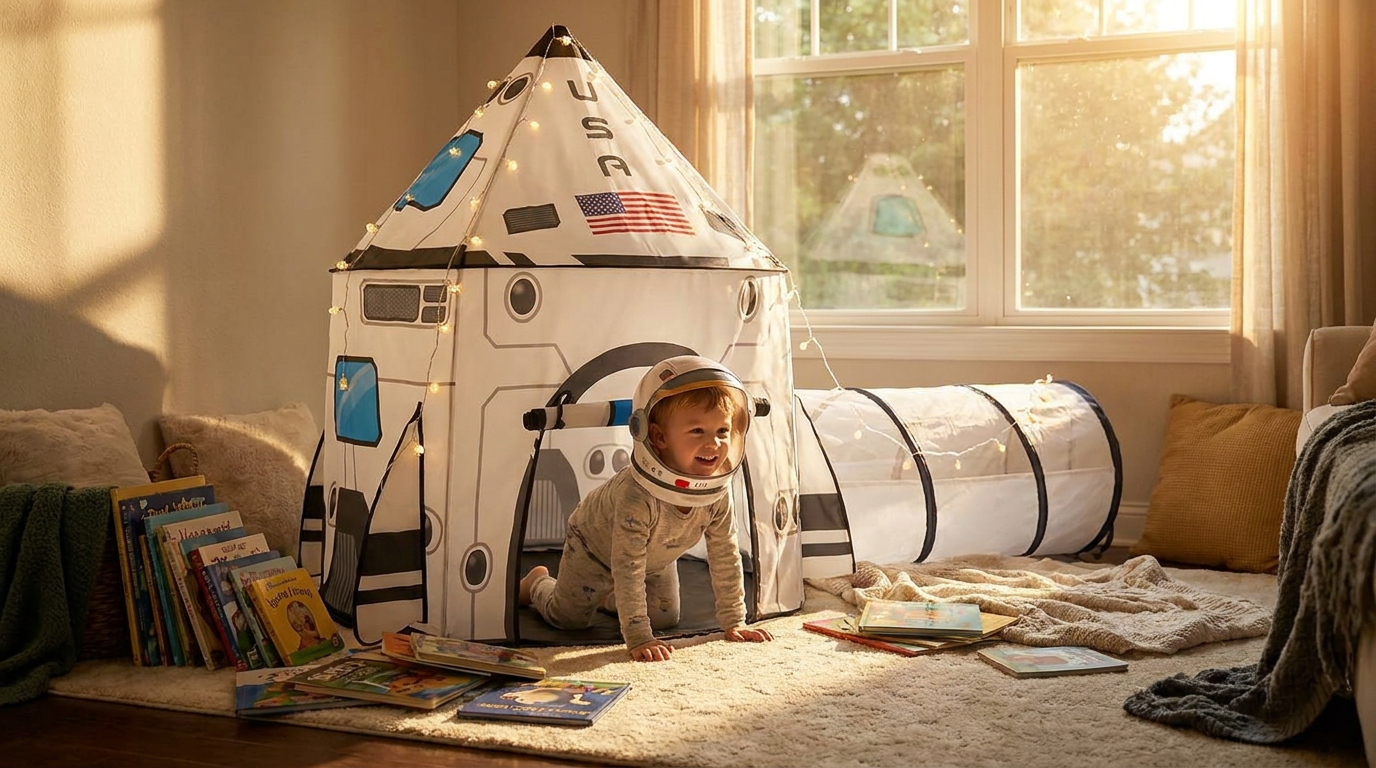
Here's the part nobody talks about: a reading nook must be physically distinct from the rest of the bedroom to be psychologically effective. The Rocket Ship Tent addresses this by creating a dedicated 360-degree environment that serves as a toddler space station playhouse. Unlike standard pop-up structures, this specific form factor provides the verticality required for a child to feel enclosed without feeling cramped. Run the math: a standard bedroom corner occupies roughly 9 to 12 square feet of floor space, which is often wasted or cluttered with miscellaneous toys. By deploying a rocket ship tent, that same footprint is converted into a high-utility zone that supports outer space bedroom decor for toddlers while serving as a functional literacy hub. The enclosure acts as a physical barrier to external stimuli, which is critical for children who struggle with the transition to quiet time. Integrating this into broader outer space bedroom decor ideas allows the tent to serve as the anchor point of the room, rather than an afterthought. The design allows for the inclusion of internal soft furnishings—such as floor cushions or bean bags—which are essential for prolonged seated activity. When building a spaceship reading nook for kids, the goal is to create a 'destination' within the room that feels separate from the sleeping and active play areas.
A Framework for Nook Implementation
To transition a simple play structure into a high-functioning reading environment, specific ergonomic and environmental criteria must be met. I’ll change my mind about open-plan reading when the metrics for sustained focus in toddlers improve, but until then, a structured enclosure remains the superior choice. Use the following checklist to audit the effectiveness of the installation:- Illumination: Install warm, low-heat LED string lights or a dedicated clip-on reading light inside the Rocket Ship Tent to prevent eye strain.
- Ergonomics: As noted by Little Peoples Cove, reading nook furniture should include soft furnishings designed to create quiet, comfortable areas; ensure the base of the tent is layered with a high-density foam mat or thick rug.
- Accessibility: Utilize low-profile, forward-facing bookshelves adjacent to the tent entrance so the child can select titles without adult assistance.
- Acoustics: Position the nook away from high-traffic doorways or shared walls where television noise might penetrate the thin fabric barrier.
- Thematic Integration: Align the internal environment with outer space bedroom decor for toddlers by using star-patterned cushions or planetary glow-decals to reinforce the 'mission' mindset.
Sources
Photo by Kindel Media on Pexels
- Reading Nook Furniture
- 28 Kids' Reading Nook Ideas for a Creative Space
- Build the Perfect Reading Nook for Your Child: Fun and ...