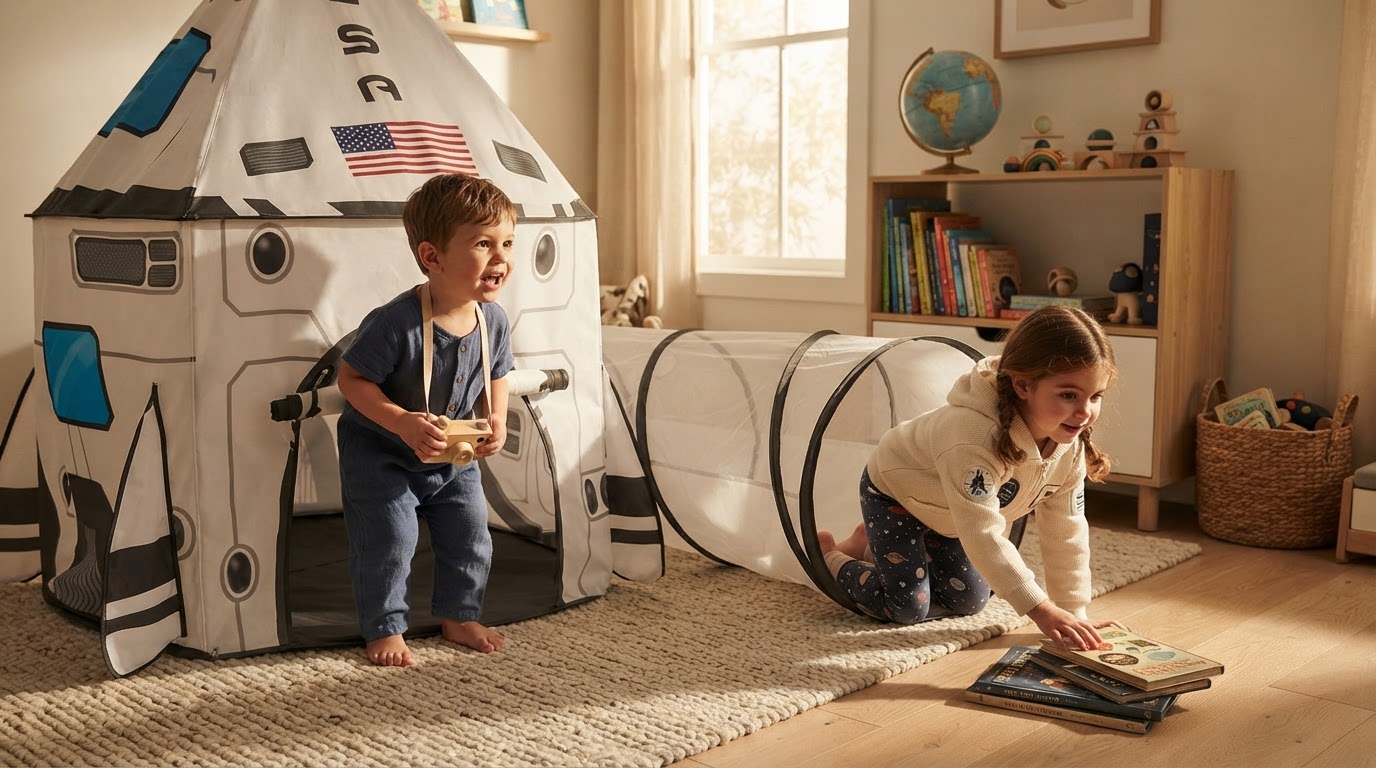
Rocket Ship Tent Solutions for Active Four Year Olds
 Jordan HaleStaff Writer
July 29, 2026. This analysis explores how the Rocket Ship Tent creates an immersive environment for preschool-aged children by bridging the gap between small-scale space toys and physical activity. It is designed for parents and educators seeking to foster imaginative play in children aged four and up.
I remember sitting on the hardwood floor of the playroom, watching my nephew try to fit his entire four-year-old frame into a cardboard box that was clearly meant for a toaster. The first thing I noticed was the sheer determination in his eyes as he tried to pilot that "vessel" to Mars. At this age, children are navigating a shift from simple tactile exploration to complex narrative roleplay. They don't just want to hold a rocket; they want to be inside one. According to the Museum of Flight Store, popular developmental tools like 3-D Glow in the Dark Planets and Stars in a Tube help set the visual stage, but they often lack the physical scale required for full-body engagement. For a child who has just mastered the motor skills to run, jump, and climb, a toy that stays on a shelf or a small play mat can feel curiously limiting. They are looking for a rocket ship play tent for kids that matches their physical energy. When we look at the broader market, we see items like the Stomp Rocket Junior or the JackInTheBox Space Explorer DIY Box, which provide excellent short-term activity. However, these often end once the rocket has landed or the box is built. The challenge for parents is finding a focal point for play that sustains interest beyond the initial assembly. A four-year-old’s imagination is a constant stream of "what if" scenarios, and their environment needs to be flexible enough to keep up with those changing stories.

Photo by Kindel Media on Pexels
Somewhere around week two of having the Rocket Ship Tent in the house, it became clear that this wasn't just a toy, but a dedicated zone for decompression and creativity. It turns out that a space themed play tent serves a dual purpose: it is a high-energy command center during the day and a quiet, enclosed sanctuary for reading by evening. The structure addresses the specific search for a rocket ship playhouse indoor that parents often prioritize for rainy days. Unlike a static model like the Blast Off Multistage Rocket, which is a fantastic piece of engineering for small hands, the tent offers a literal room for growth. The interior volume allows for a NASA rocket ship for kids experience where the child can actually bring their other toys inside—creating a sort of headquarters for their entire space fleet. I keep coming back to the way the fabric feels under tension; it is durable enough to withstand the frantic entry and exit of a toddler who has just spotted an "alien" in the hallway, yet light enough to be moved from the living room to the bedroom without a struggle. The design often incorporates features like an outer space tent with tunnel attachment, which mirrors the crawling developmental milestones that four-year-olds are still refining through play. When a child crawls through a tunnel into their toddler rocket ship tent, they are practicing spatial awareness and gross motor coordination in a way that desk-bound toys simply cannot replicate. It provides a tangible boundary for their imaginary world, helping them define the "inside" of their mission versus the "outside" of the living room carpet.
Choosing the right environment for this age group requires looking past the bright colors and focusing on the utility of the space. When evaluating a rocket ship tent for kids, the decision often rests on how well the product integrates into the existing home rhythm. A NASA rocket ship for kids theme is only as good as the play it inspires, so consider these factors when selecting a central piece for a space-themed room:
- Total footprint and ceiling height to ensure the tent doesn't overwhelm the room while remaining tall enough for a standing preschooler.
- Breathability of the fabric, ensuring that multiple children can play inside without the air becoming stuffy or uncomfortable.
- Ease of access, specifically looking for door flaps that a child can operate independently to foster a sense of autonomy.
- Compatibility with other accessories, such as whether it can accommodate a pop up rocket ship tent extension or a tunnel.
- Visual clarity of the graphics, ensuring the "control panels" and "windows" are placed at a four-year-old's eye level for maximum immersion.