Selecting Outer Space Gifts for Boys With Rocket Ship Tent
 Sam VasquezBuying Guide Lead
October 17, 2026. Finding the right balance between educational value and pure entertainment is the primary challenge when selecting outer space gifts for boys. This guide provides a framework for choosing gifts that foster long-term engagement for young explorers and aspiring astronauts.
The Challenge of Finding Engaging Space Gifts
When you start looking for space-themed gifts, you quickly realize the market is split into two camps: static models that sit on a shelf and high-energy toys that might lose their luster after an hour. According to the Smithsonian Store, the most effective gifts for space enthusiasts range from NASA apparel and striking jewelry to telescopes for sky-watchers and engaging books. While a telescope is an excellent choice for an older child with the patience for night-sky observation, younger boys often need something more tactile. The difficulty lies in the fact that many "space toys" are small-scale. A LEGO Space set or a NASA shuttle construction kit, while excellent for fine motor skills, doesn't provide a physical environment where a child can actually inhabit the role of an astronaut. If you are looking for something that bridges the gap between a toy and a piece of furniture, you have to look at the physical play space. Many parents find that their children naturally gravitate toward building forts out of blankets, which suggests that the desire for a private, themed "command center" is a universal developmental stage. Without a dedicated structure, these play zones are often temporary and cluttered, leading to a cycle of setup and teardown that discourages daily use. For those who want to encourage deep, immersive play, a larger anchor gift is necessary to set the stage for other accessories like astronaut plush figures or star chart thermoses.
Why the Rocket Ship Tent Works for Active Play
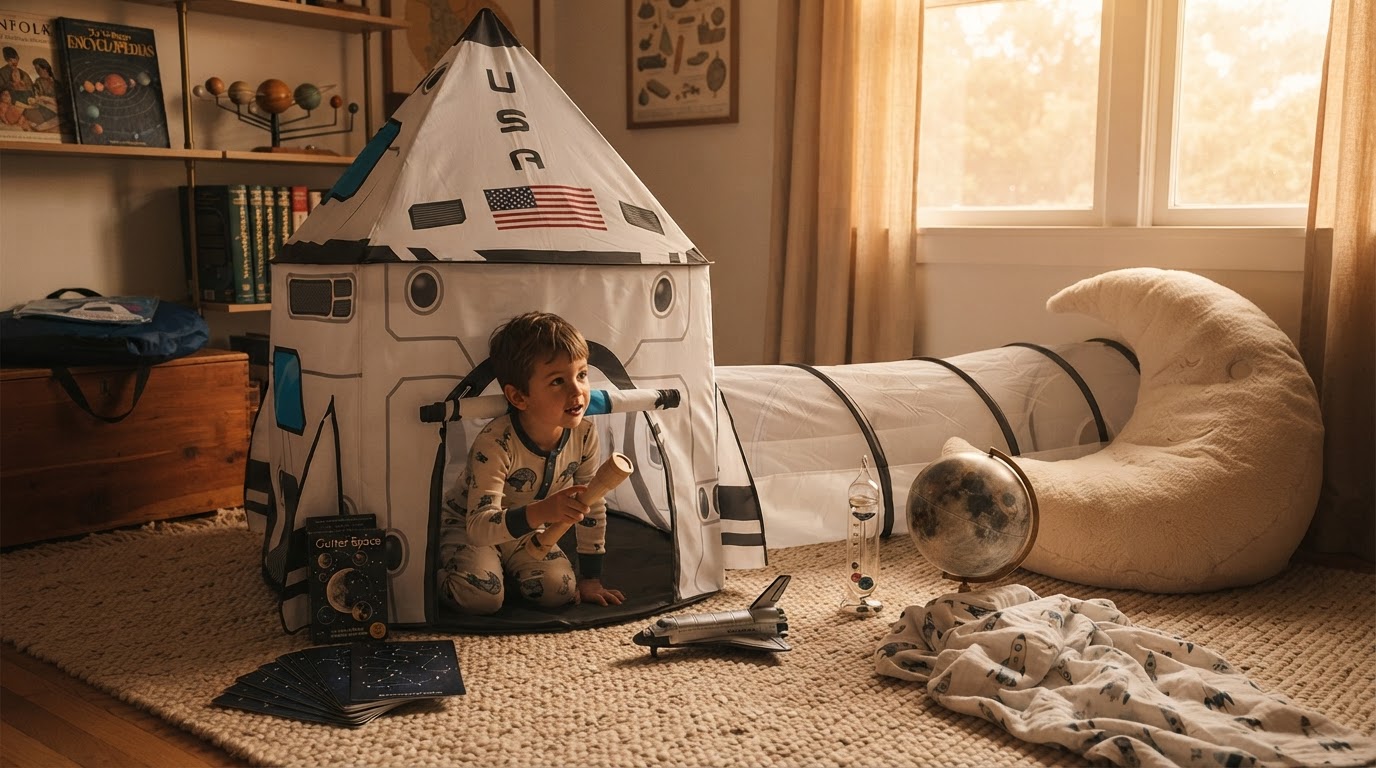
I have spent a lot of time looking at how children interact with their play areas, and the Rocket Ship Tent addresses the common complaints about indoor playhouses. Unlike a generic pop-up tent, this specific design focuses on the "rocket ship playhouse indoor" experience that parents frequently search for. It provides a defined vertical space that mimics the cramped but exciting quarters of a real spacecraft. Based on search trends for an outer space tent with tunnel, it is clear that kids value complexity in their play structures; they want to crawl, hide, and move between modules. The Rocket Ship Tent serves as the central hub for this activity. If you are considering a space themed play tent, you are looking for something that can withstand the high-energy movements of a toddler or young boy. This isn't just about the visuals—though the graphics are essential for setting the mood—it is about the footprint in the room. Between a small cardboard rocket and a durable fabric kids galaxy play tent, I'd go with the fabric option every time because it survives the inevitable roughhousing. The design allows for a kids galaxy play tent aesthetic while maintaining the structural integrity needed for a space themed play tent that gets used daily. Here's what I'd actually buy: the Rocket Ship Tent combined with a few high-quality STEM kits. This creates a multi-layered gift. The tent provides the "where," and the kits provide the "what." By setting up a space themed play tent in a corner of a bedroom or playroom, you create a permanent zone for imagination that doesn't require the constant intervention of an adult to rebuild. It handles the "toddler rocket ship tent" requirement by being simple enough for a three-year-old to enter but detailed enough for a seven-year-old to use as a base for his kids galaxy play tent adventures.
A Decision Framework for Space-Themed Purchases
When you are ready to make a purchase, you need to weigh the physical size of the gift against the child's current interests. Skip this if you have zero floor space, as a quality rocket ship tent needs a dedicated 4-foot by 4-foot area to be effective. If you're on a budget, you might be tempted to go with a small tabletop planetarium. National Geographic Kids highlights the value of a STEAM Powered Kids Space Exploration kit where kids can build and paint a planetarium or construct a space projector. These are fantastic for a rainy afternoon, but they don't solve the problem of where the child "lives" during their space play. To get the most value out of your purchase, use this checklist:
- Durability vs. Portability: Does the tent use a pop-up wire frame or a pole system? For a permanent "rocket ship playhouse indoor" setup, poles generally offer better stability.
- Interconnectivity: Does the tent support an "outer space tent with tunnel" configuration? Adding a tunnel later can extend the life of the gift by another year.
- Educational Integration: Can the play space accommodate other STEM toys? Ensure there is enough room inside for the child to sit with a book or a small solar system model.
- Ease of Maintenance: Look for polyester fabrics that can be wiped down, as space missions often involve snacks.
- Age Appropriateness: While marketed as a "toddler rocket ship tent," ensure the height allows for growth so it remains relevant as the child gets older.
Sources
- NASA Toys & Space Exploration Gear for Kids
- Gifts for Space Enthusiasts - Smithsonian Store
- OUT-OF-THIS-WORLD SPACE TOYS! - National Geographic Kids