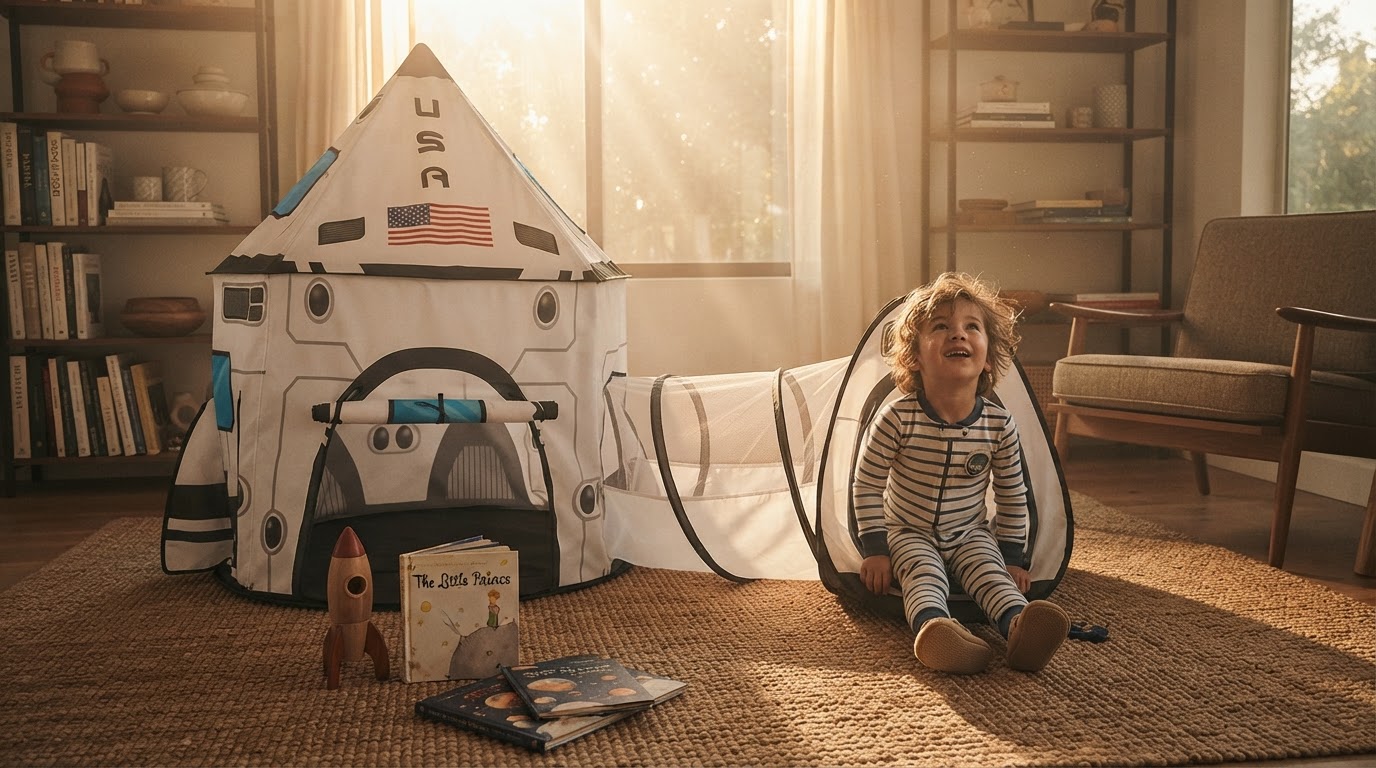
Why choose a space shuttle pop up tent for kids?
 Jordan HaleStaff Writer
August 7, 2026 — Choosing a space shuttle pop up tent provides a balance of rapid deployment and immersive role-play for young children, provided the textile quality supports repeated folding cycles.
The afternoon light was hitting the living room floor at that specific angle where every speck of dust becomes visible, and I was staring at a collapsed pile of polyester and spring steel. A space shuttle pop up tent isn't just a piece of fabric; for a four-year-old, it is a pressurized cabin waiting for a countdown. I’ve watched how these structures transform a standard Tuesday into a mission to the lunar surface, provided the gear can actually withstand the mechanical stress of a toddler's reentry.
How does the assembly of a space shuttle pop up tent work?
The assembly of a space shuttle pop up tent relies on an internal spring steel frame that tension-unfolds instantly upon removal from its storage sleeve. The first thing I noticed was how the structure essentially builds itself, snapping into a three-dimensional form with a distinct metallic 'thrum' that signals it is ready for play. It turns out that while the main body is automatic, secondary components like the nose cone or stabilizing fins often require the insertion of fiberglass poles to maintain their aerodynamic shape. According to a demonstration by Joyin, their premium spaceship design is engineered to be a foldable playground set that can be used as a standalone unit or connected to a tunnel for expanded play.
What specific features define a high-quality space shuttle tent?

Photo by cottonbro studio on Pexels
A high-quality space shuttle tent is defined by its thematic accuracy, ventilation capacity, and the durability of its floor material. I keep coming back to the tactile experience of the fabric; it needs to be light enough to be portable but thick enough to prevent the spring frame from poking through the seams after a dozen deployments. Sporty's Pilot Shop notes that their NASA Rocket Ship Pop-Up Play Tent incorporates authentic NASA and USA logos, three distinct fins, and an American Flag to enhance the realism of the play environment. These visual anchors are critical for children who are moving beyond generic playhouses and into specific aerospace interests, ensuring the tent serves as a functional prop for educational role-play.
Quick answers
Q: Can a space shuttle pop up tent be used outdoors? A: While primarily designed for indoor use, these tents can be used outdoors on dry, flat surfaces like grass, but they must be weighted down as most weigh less than 4 pounds. The lightweight polyester fabric lacks UV-stabilization, so prolonged exposure to direct sunlight may cause the NASA or USA graphics to fade over time.
Q: How long does it take to fold the tent back into its carrying bag? A: With practice, the 'twist and fold' maneuver takes approximately 15 to 30 seconds to compress the spring steel frame into a flat circle. As shown in instructional videos for the Rocket Ship 1, proper alignment of the internal loops is necessary to prevent the frame from warping during long-term storage.
Q: What is the average height of a space shuttle play tent? A: Most standard models, including those designed for toddlers, stand between 40 and 55 inches tall to accommodate a seated child and a small 'control center' setup. This height allows the tent to fit comfortably under standard 8-foot ceilings while still providing enough vertical clearance for a 4-year-old to stand partially upright.
For more specific advice on choosing the right model, see our guide on the best toddler rocket ship playhouse for indoor use or explore the Rocket Ship Tent selection framework for kids. If you are shopping for a milestone event, consider how these features fit into the best birthday gift for 4 year old boy space theme.
Learn more about Rocket Ship Tent at https://rocketshiptent.com.
Sources

- NASA Rocket Ship Pop-Up Play Tent - Sporty's Pilot Shop
- White Rocket Ship Pop Up Play Tent With Tunnel - Joyin
- How to Assemble Your Rocket Ship 1 - YouTube